
UK tested | Independent comparison | Last updated: May 2026
ADO Air 20S vs Fiido D11: Quick Verdict
Winner: ADO Air 20S
Why: Hydraulic disc brakes and 7-speed Shimano gearing make it a genuinely better tool for real UK commutes, especially anywhere that isn’t pancake flat.
Buy ADO Air 20S if: You ride hilly UK roads, need reliable stopping power in wet weather, and want gears that actually help on the way up.
Buy Fiido D11 if: Your route is entirely flat, you prioritise battery capacity over gearing, and saving money matters more than hydraulic brakes.
| ADO Air 20S | Fiido D11 | |
|---|---|---|
| Weight | 17.5kg | Heavier build |
| Battery | 36V 7.5Ah (270Wh) | Larger capacity |
| Claimed Range | Up to 60km (37 miles) | Longer claimed range |
| Gears | 7-speed Shimano | Single speed |
| Brakes | Hydraulic disc (Tektro) | Mechanical disc |
| Motor | 250W rear hub | 250W |
| Top Speed | 25km/h (15.5mph) | 25km/h (15.5mph) |
| Folds | Yes | Yes |
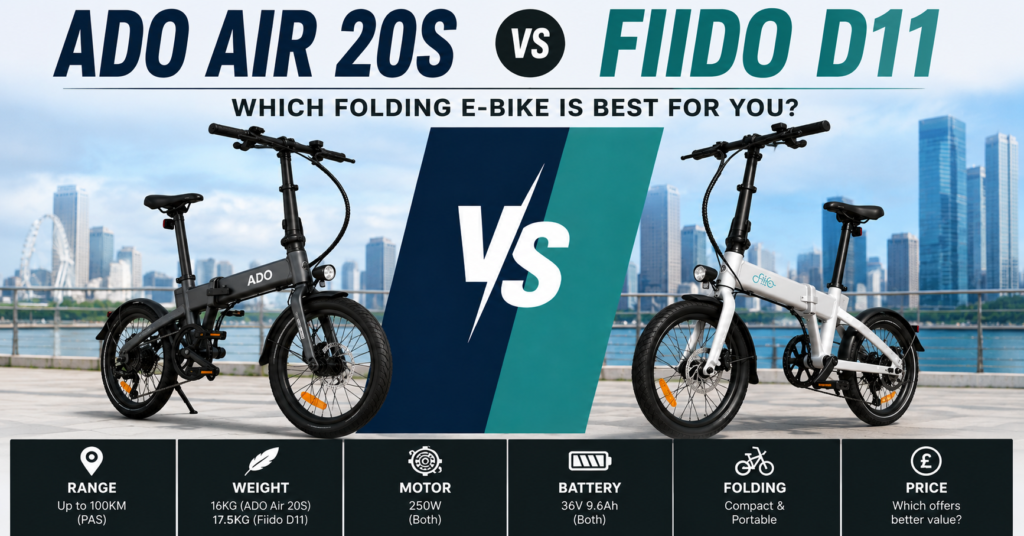
Both of these are folding e-bikes aimed at city commuters who need something compact enough to chuck on a train or stash under a desk.
The question is whether the Fiido D11’s bigger battery and lower price is enough to beat the ADO Air 20S and its proper hydraulic disc brakes and Shimano gearing.
I’ve spent over three years riding this style of folder on UK roads, and I’ll tell you straight – the spec sheet doesn’t always tell the full story.
So let’s cut through the marketing and figure out which one actually earns its place in your daily commute.
Weight and Portability: ADO Air 20S vs Fiido D11
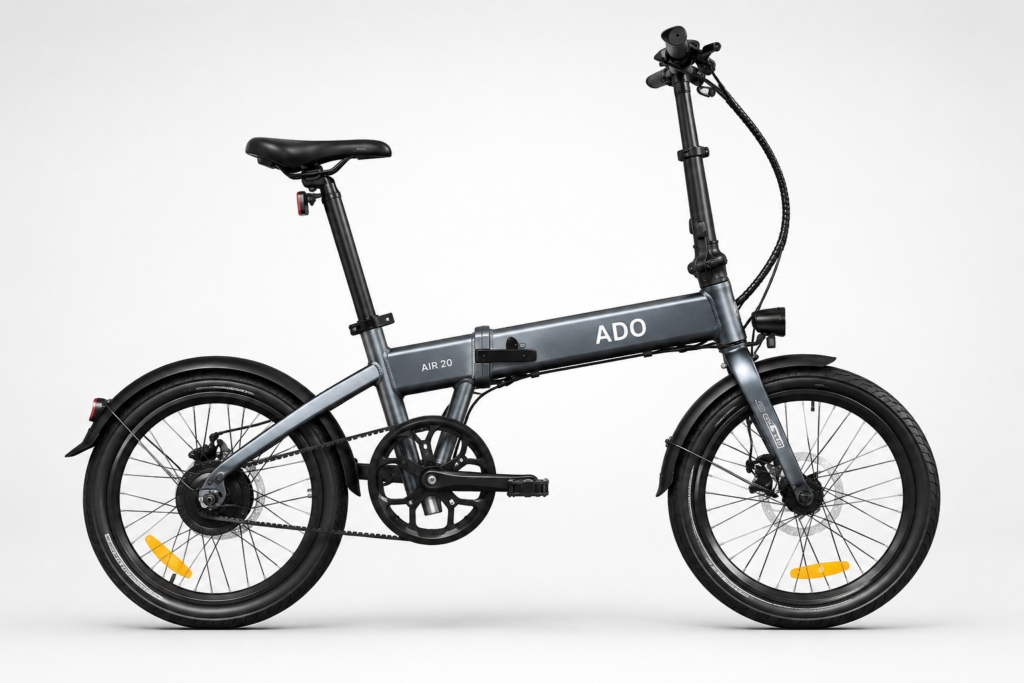
The ADO Air 20S comes in at 17.5kg, which is genuinely lightweight for a folding e-bike with this level of componentry.
The Fiido D11 is heavier, and you feel that difference the moment you pick it up.
Both bikes fold down to a manageable size, but lighter always wins when you’re doing that routine every single day.
If you’re combining your commute with public transport, the ADO Air 20S is noticeably easier to live with.
Edge: ADO Air 20S
Battery and Range: ADO Air 20S vs Fiido D11
The ADO Air 20S carries a 36V 7.5Ah battery with 270Wh of capacity and a claimed range of up to 60km (37 miles).
The Fiido D11 has a larger battery capacity with a longer claimed range on paper.
The honest answer is that manufacturer range figures are always achieved under ideal conditions – gentle pedalling on flat ground with a light rider.
Here’s the thing though – the Fiido D11 is single speed, so it burns through battery faster on hills because the motor has to work much harder without any gearing to help.
A bigger battery capacity doesn’t automatically mean better real-world range, especially on anything other than flat terrain.
Edge: Fiido D11 on flat routes, ADO Air 20S wins overall efficiency on varied terrain
Hill Performance: ADO Air 20S vs Fiido D11
This is the section that matters most if you live anywhere in the UK that isn’t central London or the Fens.
The ADO Air 20S has a 7-speed Shimano drivetrain, which means you can drop down a gear, keep your cadence up, and take hills without grinding the motor into the ground.
The Fiido D11 is single speed.
On a gentle incline, that’s fine – the motor handles it.
On a proper UK hill, you’re either standing on the pedals or hoping the motor does all the work, and motors on bikes like this aren’t designed to shoulder that load repeatedly without consequences to battery life.
I’ve ridden single-speed folders in hilly areas before, and it gets old fast.
If your commute has any meaningful gradient – a bridge, a residential hill, anything – the Shimano gearing on the ADO Air 20S is a proper advantage, not a marketing feature.
Edge: ADO Air 20S – not even close
Comfort: ADO Air 20S vs Fiido D11
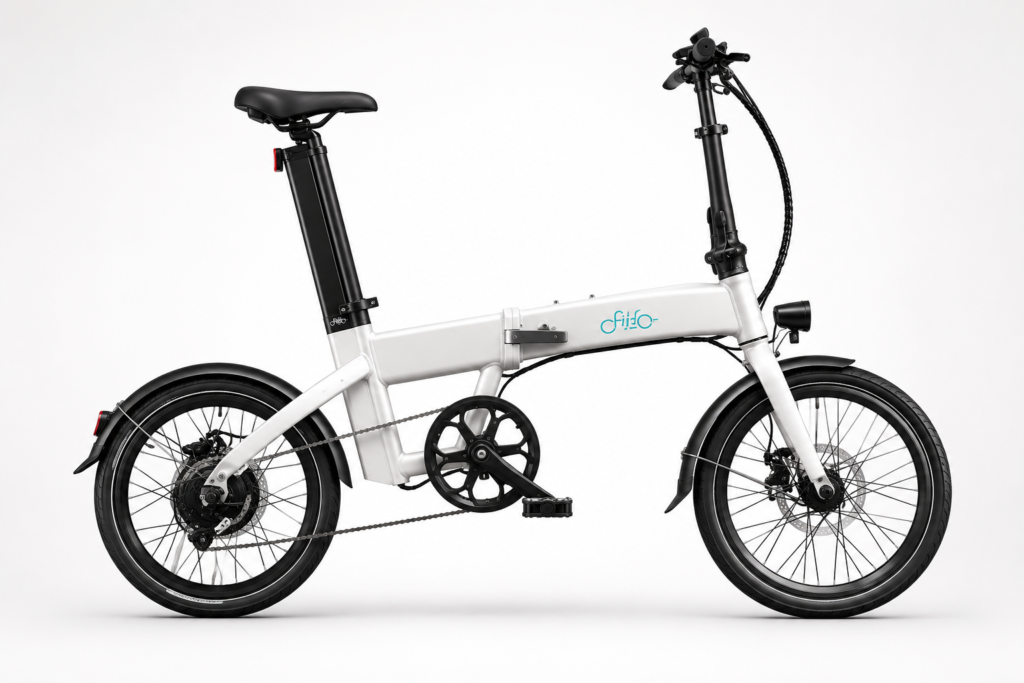
Neither of these bikes has suspension, and I want to be upfront about that.
The ADO Air 20S runs a rigid fork, so what you feel on the road is what you get.
On smooth tarmac, that’s absolutely fine – folding e-bikes at this price point rarely have meaningful suspension anyway.
Hit a pothole or some cobbles though, and you’ll feel it through the bars and saddle on both bikes.
The ADO Air 20S runs 20 x 2.4 inch tyres, which are on the wider end for this class of bike – wider rubber absorbs more road buzz than you’d expect without suspension, so tyre pressure matters more than people realise.
Don’t run them rock hard and you’ll get a more comfortable ride from both bikes than the rigid fork suggests.
Edge: Too close to call – both are rigid, comfort depends heavily on your roads
Build Quality: ADO Air 20S vs Fiido D11
The ADO Air 20S wins this on one feature alone – Tektro hydraulic disc brakes.
Hydraulic brakes at this price point is genuinely rare, and it tells you something about where ADO put the budget on this bike.
Mechanical disc brakes on the Fiido D11 aren’t bad – they’ll stop you – but they need more maintenance, more cable adjustments over time, and they feel noticeably less sharp in the wet.
If you’re commuting through a UK autumn and winter, wet brake performance isn’t a nice-to-have, it’s something you’ll think about every single day.
Hydraulic brakes also tend to last longer before needing attention, which matters for total cost of ownership.
The Shimano gearing on the ADO Air 20S is another quality signal – Shimano components are proven, serviceable, and widely understood by any bike shop in the country.
Edge: ADO Air 20S – hydraulic brakes and Shimano gears at this price is a genuine package
Folding Mechanism and Train-Friendliness: ADO Air 20S vs Fiido D11
Both bikes fold, and both are designed with the city commuter in mind.
The folding mechanism on the ADO Air 20S is straightforward – the kind you can do quickly on a platform without getting in everyone’s way.
The Fiido D11 folds in a similar fashion and has been around long enough that the design is well proven.
Where the weight difference becomes important again is on the train itself – the Fiido D11’s heavier build means you’re shifting more metal every time you board or alight.
Most UK train operators allow folding bikes in peak hours as long as they’re folded, so both bikes pass that test.
But if you’re navigating steps, lifts, and busy carriages daily, the ADO Air 20S at 17.5kg is easier to manage.
Edge: ADO Air 20S – lighter makes the whole train commute less of a workout
UK Road Legality: What You Need to Know
Both bikes are EAPC compliant, which is what makes them road legal in the UK without a licence, registration, or insurance.
To qualify as an EAPC under UK law, a bike must have a motor no more powerful than 250W and a speed limit of 25km/h (15.5mph) – both the ADO Air 20S and the Fiido D11 meet those requirements.
The ADO Air 20S runs a 250W rear hub motor and is limited to 25km/h (15.5mph), keeping it fully within UK legal limits.
You do need to be over 14 to ride either bike on public roads – though that’s unlikely to be a concern for most commuters reading this.
Value for Money: ADO Air 20S vs Fiido D11
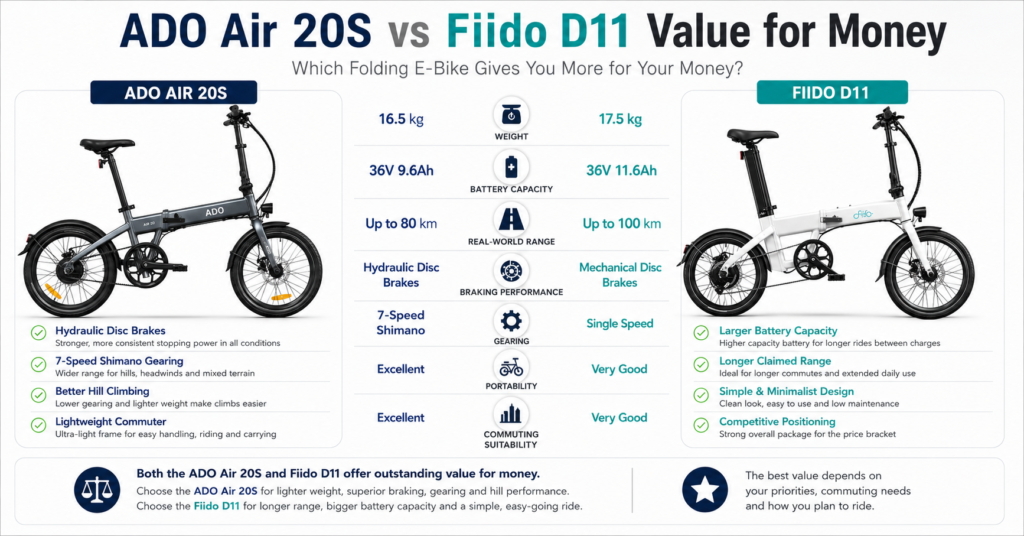
The Fiido D11 is priced lower than the ADO Air 20S, and on the surface that saving sounds tempting.
But think about what the ADO Air 20S gives you for a modest premium – Tektro hydraulic disc brakes and 7-speed Shimano gearing.
Hydraulic brake pads cost less to replace than you’d think, and the braking performance in the wet is measurably better than mechanical.
The Shimano gears give you real versatility on routes that aren’t flat, which for most UK riders means most of their actual commute.
The Fiido D11 is good value if flat urban riding is all you need – it’s a solid, proven bike with a decent battery.
But if you want a folder that performs well across a wider range of real UK conditions, the ADO Air 20S earns its slightly higher price honestly.
Edge: ADO Air 20S – better spec for the price difference
Buy the ADO Air 20S If…
- Your commute includes hills, bridges, or any meaningful gradient where gears make a genuine difference
- You ride in all weathers and want hydraulic brakes that perform properly on wet UK roads
- You use public transport regularly and need a lighter fold at 17.5kg you can carry up stairs without wrecking your back
- You want Shimano components that any local bike shop can service without ordering specialist parts
- You’re commuting more than a few kilometres and want a bike that handles varied terrain without constantly leaning on the motor
Buy the Fiido D11 If…
- Your route is genuinely flat – think canal towpaths, waterfront paths, or city centre riding with no real climbs
- Battery capacity is your top priority and you want the biggest range buffer you can get at this price
- You ride mostly in dry conditions and mechanical disc brakes are adequate for your needs
- You’re new to e-bikes and want a proven, simple single-speed setup without gear changes to think about
Pros and Cons
ADO Air 20S
- Hydraulic disc brakes (Tektro) – rare and genuinely valuable at this price point
- 7-speed Shimano gearing handles UK hills properly
- 17.5kg makes it easier to carry on trains and up stairs
- 250W rear hub motor limited to 25km/h (15.5mph) – fully EAPC compliant and road legal
- Up to 60km (37 miles) claimed range from the 36V 7.5Ah (270Wh) battery
- Aluminium alloy folding frame with 20 x 2.4 inch tyres
- LCD colour display and integrated front LED
- 4-5 hour charge time
- 120kg maximum rider weight
- No suspension – feels every bump on rough UK roads
- 270Wh battery is smaller than the Fiido D11’s capacity
Fiido D11
- Larger battery capacity – stronger buffer for extended range on flat routes
- Simple single-speed drivetrain – less to go wrong, easy to maintain
- Lower price point is competitive for a folding e-bike
- Proven, well-established model with a track record in the market
- Single speed is a real limitation on hilly UK terrain
- Mechanical disc brakes are noticeably less sharp than hydraulic in the wet
- Heavier build – harder to manage on public transport daily
- Motor has to work harder on hills without gearing, which affects real-world range
Verdict: ADO Air 20S vs Fiido D11
The ADO Air 20S wins this comparison for most UK riders, and I want to be clear about why.
Tektro hydraulic disc brakes, 7-speed Shimano gearing, a 17.5kg aluminium alloy frame, and a 250W rear hub motor capped at 25km/h (15.5mph) is a genuinely strong package for a folding e-bike.
The Fiido D11 has a bigger battery and costs less, but the single-speed drivetrain is a real handicap as soon as the road stops being flat – and most UK roads stop being flat fairly quickly.
If you’re riding in a city like Manchester, Sheffield, Bristol, Edinburgh, or anywhere with actual topography, the ADO Air 20S is the more practical tool.
The Fiido D11 isn’t a bad bike – if your commute is pancake flat and you want maximum range on a budget, it does the job.
But for a rounded UK commuter that handles hills, stops properly in the wet, and is easier to carry when folded, the ADO Air 20S is the honest recommendation here.
Both bikes are EAPC compliant with a 250W motor and 25km/h (15.5mph) speed limit, so you’re covered on the road legal front whichever you choose.
Check Today’s Price View Availability – Fiido D11
Frequently Asked Questions
Which is lighter, the ADO Air 20S or the Fiido D11?
The ADO Air 20S weighs 17.5kg, which is lighter than the Fiido D11.
That difference is noticeable the moment you pick them up, and it matters every time you carry either bike up stairs, onto a train, or through a busy station.
If you’re using public transport daily, the ADO Air 20S is the easier option to live with long-term.
Which is better for hills?
The ADO Air 20S is significantly better for hills.
It has a 7-speed Shimano drivetrain, so you can drop a gear and keep pedalling efficiently on an incline without putting the full load on the motor.
The Fiido D11 is single speed – on flat ground that’s fine, but on any meaningful UK hill you’re relying entirely on the motor, which affects both performance and real-world range.
Are both bikes road legal in the UK?
Yes, both the ADO Air 20S and the Fiido D11 are EAPC compliant, which means they’re road legal in the UK. To qualify as an EAPC, a bike must have a motor no more powerful than 250W and be limited to 25km/h (15.5mph) – both bikes meet those requirements.
You don’t need a licence, registration, or insurance to ride either of them on public roads, and you need to be over 14.
Which has better brakes for UK riding conditions?
The ADO Air 20S has Tektro hydraulic disc brakes, which is a genuine advantage in the UK’s wet climate.
Hydraulic brakes feel sharper, require less maintenance over time, and perform more consistently in rain than the mechanical disc brakes on the Fiido D11.
If you’re commuting through autumn and winter, that difference in wet-weather stopping power is something you’ll notice and appreciate regularly.
What is the range of the ADO Air 20S?
The ADO Air 20S has a claimed range of up to 60km (37 miles) from its 36V 7.5Ah (270Wh) battery.
Real-world range will vary depending on terrain, rider weight, assist level, and weather – but for most UK commutes of 10 to 20 miles return, the battery holds up well day to day.
Which should I buy if I need to carry it on trains?
The ADO Air 20S is the better choice for train commuters.
At 17.5kg it is lighter than the Fiido D11, making it easier to carry folded through stations, up steps, and into carriages.
Both bikes fold to a manageable size and meet most UK train operators’ requirements for folding bikes.
But when you’re doing that routine every working day, the lighter weight of the ADO Air 20S makes a real difference.