
About this review: I am David Frew, founder of escootersandbikes.com.
I personally own the DYU A5 and have ridden it over 1,500km on UK roads.
I have also tested the Engwe EP-2 Pro extensively.
This comparison contains affiliate links marked with an asterisk – they cost you nothing extra and help keep this site running.
Every opinion here is my own.
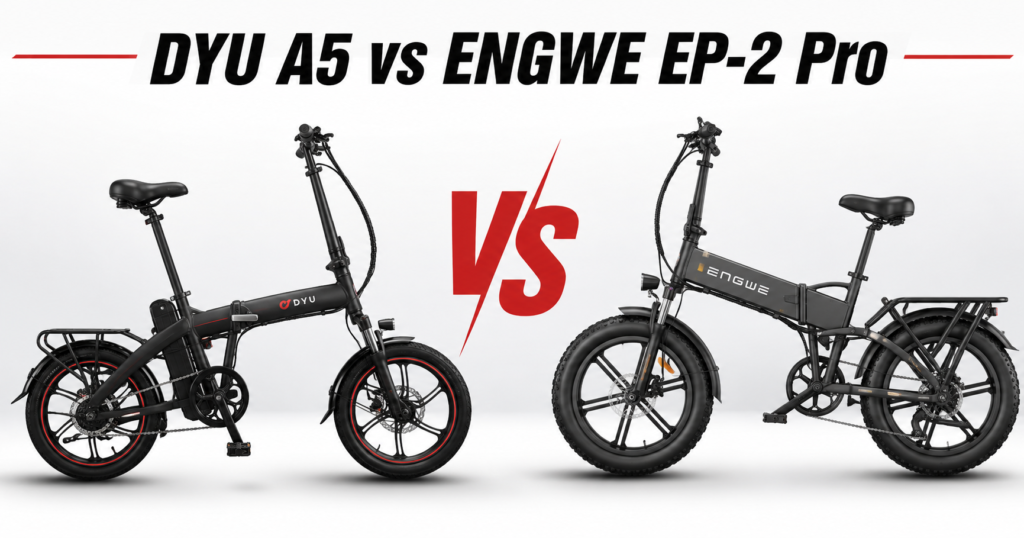
DYU A5 vs Engwe EP-2 Pro: Which Folding E-Bike Should You Actually Buy in the UK?
I am going to be straight with you from the start.
I own a DYU A5.
It is downstairs right now.
I have put 1,500km on it across UK roads – commutes, weekend rides, wet Tuesdays, sunny Saturdays, the lot.
So when someone asks me about the DYU A5 vs Engwe EP-2 Pro, I am not reading off a spec sheet.
I am telling you what I actually know.
And the honest answer is: these two bikes are aimed at very different riders, even though they look similar on paper.
One is a brilliant lightweight commuter.
The other is a capable do-everything machine that weighs about as much as a small person.
By the end of this article, you will know exactly which one you should be spending your money on.
Quick Verdict
Buy the DYU A5 if: you need a lightweight bike you can carry upstairs, onto public transport, or store in a small flat.
At 17.5kg, it is genuinely portable.
At around £599-£699, it is excellent value for an EAPC-legal UK commuter.
Buy the Engwe EP-2 Pro if: you want fat tyres, better range, front suspension, and you are not going to need to lift it very often.
The 30kg weight is the catch.
But the capability is real.
My honest split: urban commuter with stairs or trains – DYU A5, every single time.
Weekend rider who wants a more capable machine and has a ground-floor flat or garage – Engwe EP-2 Pro.
Check Latest UK Price at DYU ->
Check Latest Price at Ride and Glide ->
DYU A5 vs Engwe EP-2 Pro: Key Differences at a Glance
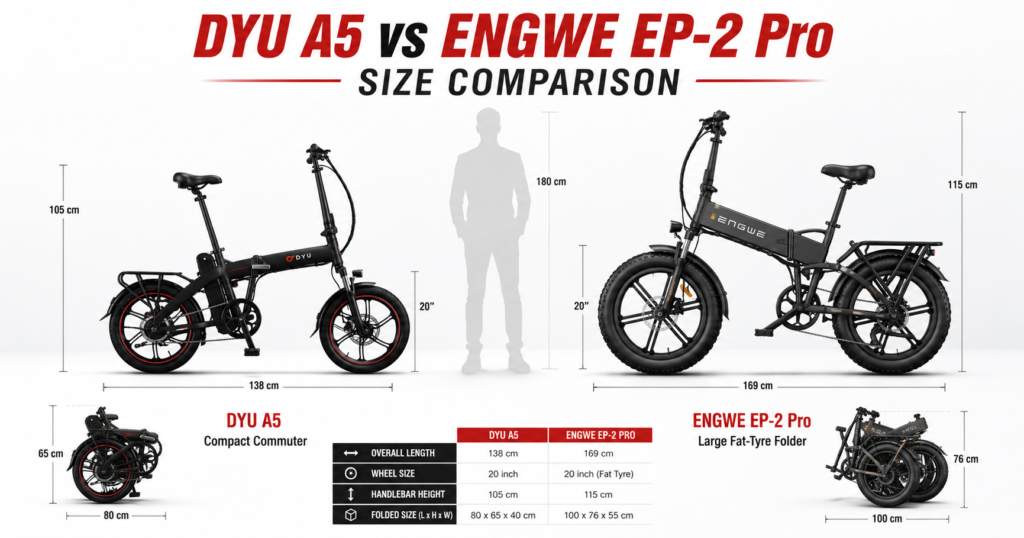
Before we get into the detail, here is the head-to-head comparison.
These are real-world numbers based on actual UK riding, not manufacturer best-case figures.
| DYU A5 | Engwe EP-2 Pro | |
|---|---|---|
| Price (approx) | £599 – £699 | £699 – £799 |
| Weight | 17.5kg | 30kg |
| Real-World Range | 35 – 50km | 40 – 60km |
| Battery | 36V 10Ah (360Wh) | 48V 12.8Ah (614Wh) |
| Motor | 250W rear hub | 250W rear hub (750W peak) |
| Tyre Size | 20 inch standard | 20 x 4.0 inch fat tyre |
| Suspension | None | Front fork |
| UK Legal (EAPC) | Yes | Yes |
| Best For | Urban commuting, small flats, trains | Rough roads, heavier riders, mixed use |
| Our Score | 9/10 for commuters | 8.5/10 for all-rounders |
The DYU A5: What 1,500km Taught Me
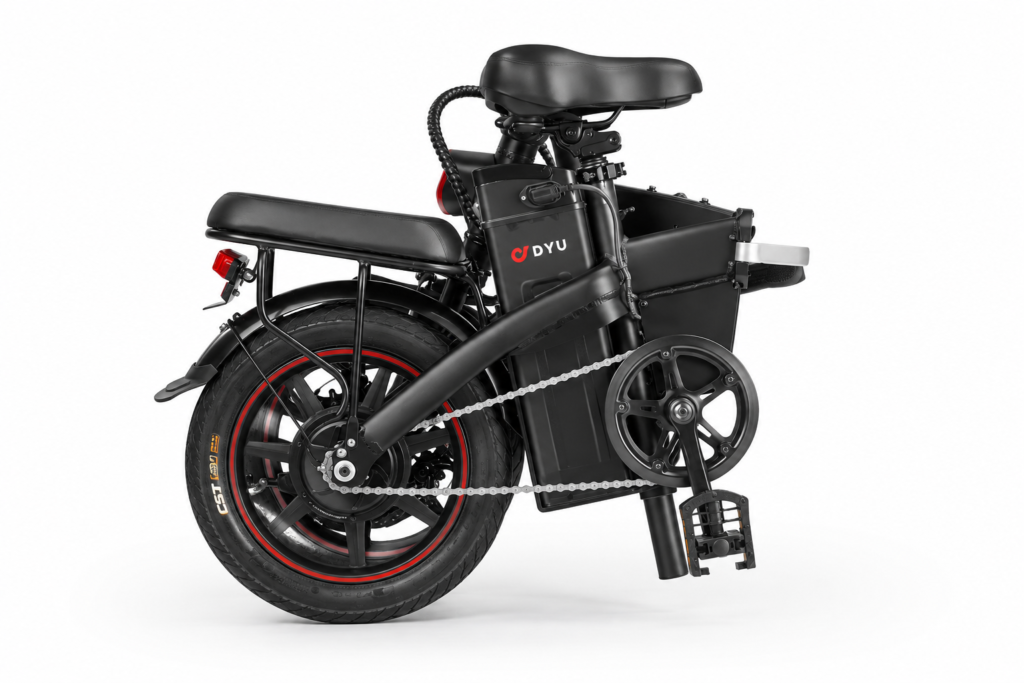
I bought my DYU A5 because I needed something I could genuinely live with in the UK.
Not a showroom bike.
Not a spec sheet impressive.
An actual daily rider for actual British roads and actual British weather.
After 1,500km, here is what I can tell you with total confidence.
The weight is the killer feature.
17.5kg sounds like a number until you have tried to haul a 30kg bike up two flights of stairs at 7:30 in the morning.
At 17.5kg, the DYU A5 is manageable for almost anyone.
I carry mine upstairs without breaking a sweat.
I have put it in the boot of a small hatchback without needing a second pair of hands.
That genuinely matters.
The motor is 250W, which puts it comfortably within UK EAPC rules for electrically assisted pedal cycles.
No licence, no insurance, no registration.
Just ride it.
The range of 35 to 50km in real-world UK conditions is honest and consistent.
I have done 40km runs on a single charge in assist level 2 without any drama.
For a daily commute, it more than covers the average UK journey.
The 20-inch wheels roll well on tarmac, and the build quality has held up over 1,500km without a single mechanical issue worth mentioning.
It is not flashy.
It does not need to be.
Where the DYU A5 falls short
I will not dress this up.
The battery is the weakest part of the DYU A5 story when you compare it to the Engwe.
360Wh versus 614Wh is a meaningful gap.
If you regularly do 40+ km rides or ride in hilly areas with the assist cranked up, you will feel that smaller battery.
There is no suspension.
On smooth UK cycle paths this is absolutely fine.
On potholed B-roads or gravel tracks, you will feel every bump through your wrists and backside.
The standard 20-inch tyres also lack the cushioning confidence of fat tyres on rougher surfaces.
If your commute includes rough paths or you want a bike for mixed terrain, the DYU A5 is not your answer.
But if you want the best lightweight folding commuter under £700 in the UK right now, it absolutely is.
Check Latest UK Price at DYU ->
The Engwe EP-2 Pro: The Fat Tyre Alternative
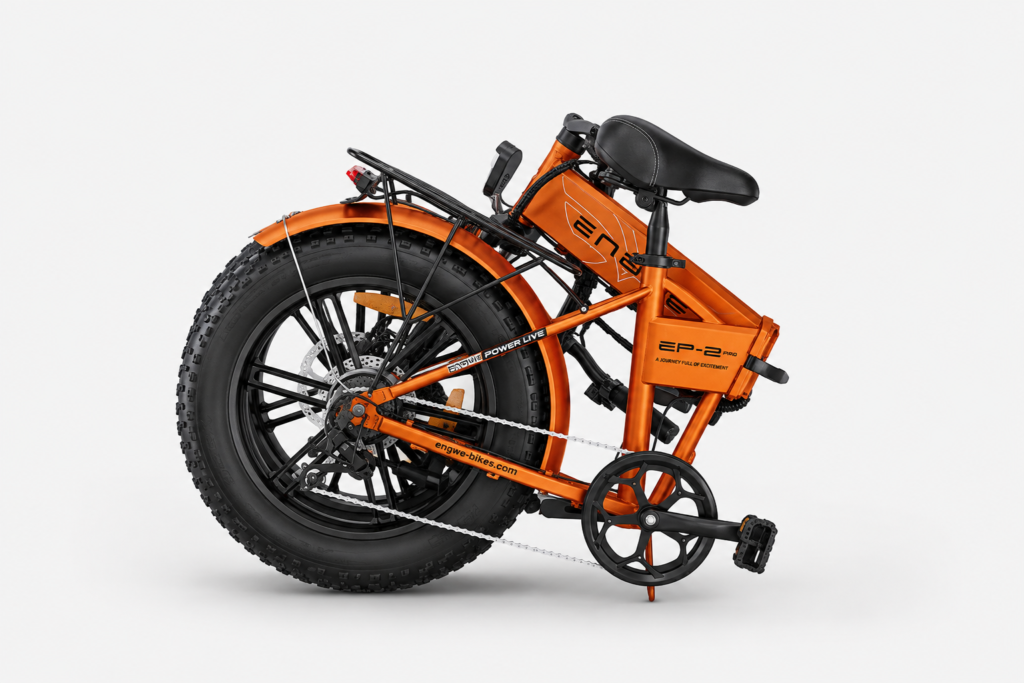
The Engwe EP-2 Pro is a genuinely different proposition.
This is not just a slightly better DYU A5.
It is a different category of bike wearing a similar price tag.
The fat tyres are the headline feature, and they earn that billing.
20 x 4.0 inch tyres paired with a front suspension fork turn what would otherwise be a jarring ride on UK roads into something genuinely comfortable.
If your route includes speed bumps, canal towpaths, gravel, or the kind of potholed tarmac that most British roads seem to specialise in, those fat tyres are not a gimmick.
They are a genuine quality-of-life upgrade.
The battery is the other headline.
614Wh is nearly double the DYU A5’s capacity.
In real-world UK riding that translates to 40 to 60km of assisted range, and with the higher 48V voltage, the motor feels punchier and more responsive at higher assist levels.
The 750W peak output also means it handles hills and headwinds without the slight strain you can feel on the DYU in challenging conditions.
For heavier riders – and I mean that without judgement, physics is physics – the Engwe EP-2 Pro is the more comfortable and capable choice.
The fat tyres and stronger motor system simply handle additional weight more confidently.
The one thing you cannot ignore about the Engwe EP-2 Pro
30kg.
That is what this bike weighs.
Let that sink in for a moment.
The DYU A5 weighs 17.5kg.
The Engwe EP-2 Pro weighs 30kg.
That is 12.5kg of extra bike you are committing to every time you need to carry it anywhere.
Upstairs to a first-floor flat?
Genuinely hard work.
Onto a train during rush hour?
A significant ask.
Into a compact car boot without help?
Good luck with your back.
If portability matters to you at all – and for most UK city riders it does – the Engwe’s weight is not a minor consideration.
It is the central consideration.
The bike folds, yes.
But a folded 30kg bike is still a very heavy thing to lift.
Check Latest Price at Ride and Glide ->
DYU A5 vs Engwe EP-2 Pro: What Actually Matters Day to Day
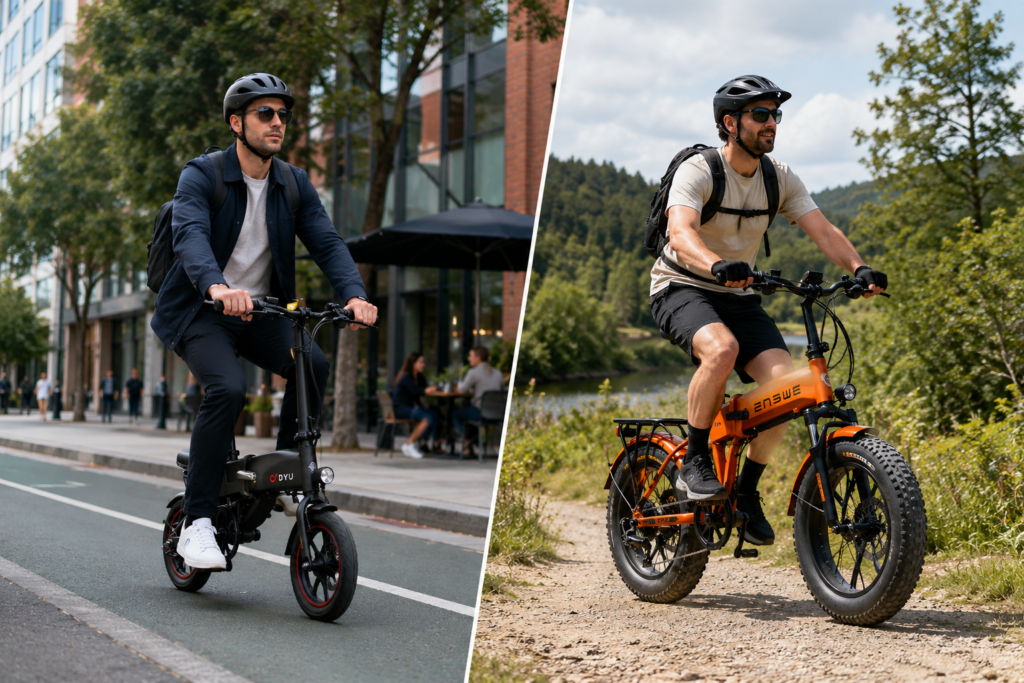
Specs are easy to write down.
What is harder is working out which specs actually change your daily life.
Here is what genuinely separates these two bikes when you ride them.
Weight and Portability
This is where the DYU A5 wins.
Clearly and decisively.
12.5kg is a lot of difference when you are lifting a bike.
Most UK cyclists who commute by e-bike will encounter at least one of the following: stairs at home, stairs at work, tube or train carriages, a car boot, or an awkward gate.
At 17.5kg, the DYU A5 handles all of those situations without turning every journey into a logistical challenge.
At 30kg, the Engwe EP-2 Pro really wants you to have a ground-floor home, a lift at work, and a large car.
If you are in a flat, use public transport, or simply value being able to move your bike without straining yourself, the DYU A5 is not just better – it is the only sensible choice.
Range and Battery
The Engwe wins here.
No argument.
614Wh versus 360Wh is a near doubling of battery capacity, and in real-world UK terms that means more range buffer, more confidence on longer rides, and less anxiety about running low mid-commute.
The DYU A5’s 35 to 50km real-world range is genuinely good for a bike at this price point, but if your daily commute is 20km each way, the Engwe gives you far more breathing room.
The 48V system on the Engwe also delivers more consistent power throughout the battery’s discharge cycle.
The DYU’s 36V system can feel slightly softer as the battery depletes.
Range matters more than most buyers initially think.
A bigger battery is almost always worth having.
Ride Quality and Comfort
The Engwe wins on rough surfaces.
The DYU A5 wins on smooth tarmac efficiency.
Fat tyres plus front suspension fork on the Engwe genuinely soften the road.
If your commute involves canal paths, gravel sections, rough back streets, or the kind of lumpy tarmac that British councils seem incapable of fixing, the Engwe EP-2 Pro will feel noticeably more comfortable.
On smooth tarmac and good cycle paths, the DYU A5’s standard tyres and rigid frame are perfectly comfortable and roll efficiently.
The honest answer: most UK commuters ride primarily on tarmac, which makes the fat tyres a nice-to-have rather than a must-have for everyday use.
For weekend adventures on rougher terrain, the Engwe is meaningfully better.
Value for Money
Both bikes are good value.
Neither is a rip-off.
The DYU A5 at £599 to £699 gives you an excellent, lightweight, EAPC-legal UK commuter with a reliable motor and honest range.
For pure commuter value per pound, it is outstanding.
The Engwe EP-2 Pro at £699 to £799 costs roughly £100 more and gives you fat tyres, front suspension, and a significantly bigger battery.
For what you get, the extra money is genuinely justified – if those features match your actual riding needs.
The mistake buyers make is paying for capability they do not need.
If you ride smooth tarmac every day and never need to carry the bike anywhere, the Engwe EP-2 Pro’s extra features make sense.
If you need something light and portable, paying more for a heavier bike is the wrong call.
Who Should Buy the DYU A5?
The DYU A5 is the right bike if you are:
- A daily commuter in a UK city who values being able to carry their bike up stairs or onto public transport
- Living in a flat without a ground-floor storage option
- Someone who needs their e-bike to fit in a car boot alongside other things
- A lighter rider who does not need the extra support of fat tyres
- Riding primarily on tarmac cycle paths and roads
- Buying your first e-bike and wanting something manageable and simple
- Working to a budget closer to £600 than £800
- Prioritising reliability and low-maintenance simplicity over maximum features
Check Latest UK Price at DYU ->
Who Should Buy the Engwe EP-2 Pro?
The Engwe EP-2 Pro is the right bike if you are:
- A rider who wants a genuinely comfortable ride on rough or mixed-surface UK roads
- Someone with a longer commute – 30km or more each way – who needs the extra battery range
- A heavier rider who will benefit from the fat tyre support and stronger motor system
- Storing your bike in a garage, shed, or ground-floor space where lifting is not an issue
- Using your e-bike for weekend leisure rides as well as weekday commuting
- Riding on gravel paths, canal towpaths, or poorly maintained roads regularly
- Someone who will genuinely use the front suspension and not just be paying for it
- Not reliant on public transport as part of your commute
Check Latest Price at Ride and Glide ->
DYU A5 vs Engwe EP-2 Pro: My Final Verdict

I have ridden 1,500km on the DYU A5.
I know this bike.
And I am going to be completely honest with you about both of them.
The DYU A5 vs Engwe EP-2 Pro comparison does not have a single winner.
It has a right answer for two different types of rider.
If you are a UK urban commuter who needs a bike you can actually live with in a normal British home – a flat, a small house, a life that involves stairs and trains and tight spaces – the DYU A5 is the better choice.
It is lighter by a significant margin.
It is simpler.
It is cheaper.
And after 1,500km on UK roads, I can tell you it is genuinely reliable.
The Engwe EP-2 Pro is a more capable bike.
Bigger battery, fat tyres, front suspension – on paper it looks like the obvious winner.
But 30kg is a real problem for real people in real British living situations.
That weight does not go away just because the bike folds.
For weekend riders, heavier riders, mixed-terrain riders, and anyone with ground-floor storage and no train commute, the Engwe EP-2 Pro is genuinely excellent and worth every penny of the extra cost.
For everyone else, the DYU A5 is the smarter, lighter, more practical choice.
Both are EAPC compliant under UK law and legal to ride on UK roads and cycle paths without a licence.
That bit, at least, is simple.
Choose based on your actual life, not the spec sheet.
Check Latest UK Price at DYU ->
Check Latest Price at Ride and Glide ->
Frequently Asked Questions
Is the DYU A5 or ENGWE EP-2 Pro better for commuting?
The DYU A5 is generally the better commuter e-bike thanks to its lighter weight, smaller folded size and easier portability.
It is particularly suitable for train journeys, office storage and city riding.
Which bike has the better range?
The ENGWE EP-2 Pro typically offers a longer real-world range due to its larger battery capacity.
Riders travelling longer distances or tackling hilly routes may benefit from the extra battery performance.
Is the ENGWE EP-2 Pro too heavy for everyday use?
Not necessarily, but at around 30kg it is significantly heavier than the DYU A5.
If you regularly carry your bike upstairs or lift it into a vehicle, the weight difference is noticeable.
Which bike is more comfortable on rough roads?
The ENGWE EP-2 Pro is more comfortable on rough surfaces thanks to its fat tyres and front suspension.
The DYU A5 is better suited to smoother roads and urban cycle paths.
Which folding e-bike offers the best value for money?
The answer depends on your needs.
The DYU A5 offers excellent value for commuters who prioritise portability, while the ENGWE EP-2 Pro provides more versatility, comfort and range for riders who need a larger e-bike.